

Rendering Melbourne homes and commercial buildings covers a lot more ground than the word "render" suggests on its own. Cement rendering, the traditional sand-and-cement system that's been used across this city for generations, still gets specified constantly — alongside newer acrylic and polymer systems that have taken over a big share of new-build facades in the last decade. Then there's the whole separate world of commercial rendering Melbourne developers rely on, which runs on different timelines, different compliance requirements and a very different scale to a single residential facade. Best Rendering Group works across all three of these categories, and it's worth understanding how they actually differ before you start pricing a job.
The short version: cement rendering is the older, more rigid, more traditional system, still genuinely the right choice for certain heritage and masonry applications. Acrylic and polymer-modified systems have largely taken over residential new-build work because they flex with the ground movement common across Melbourne's clay-heavy soils. And commercial rendering is less about which product goes on the wall and more about coordinating a much bigger job across scaffolding, multiple trades, and a program that usually can't afford delays.
There isn't a single "best" system here — the right choice depends heavily on the substrate, the building's age, and what it's actually trying to achieve.
A sand, cement and lime mix applied directly over brick or masonry, built up in coats and hand-trowelled to a finish. Cement rendering has genuine longevity when done properly and remains the correct choice for a lot of heritage restoration and solid masonry work, where its rigidity matches the wall underneath. For lightweight alternatives on modern builds, see our Hebel Installation services.
A more flexible, polymer-based system that copes better with the seasonal ground movement common across a lot of Melbourne's newer growth-corridor suburbs. It's largely become the default for new residential builds, offering a wider colour range and generally faster application than a traditional cement rendering system. For projects exploring lightweight facade systems, our Foam Installation service complements acrylic rendering well.
Both cement and acrylic systems can be finished smooth, sponge-textured or spatterdash, giving a wide range of looks regardless of which base system is chosen underneath.

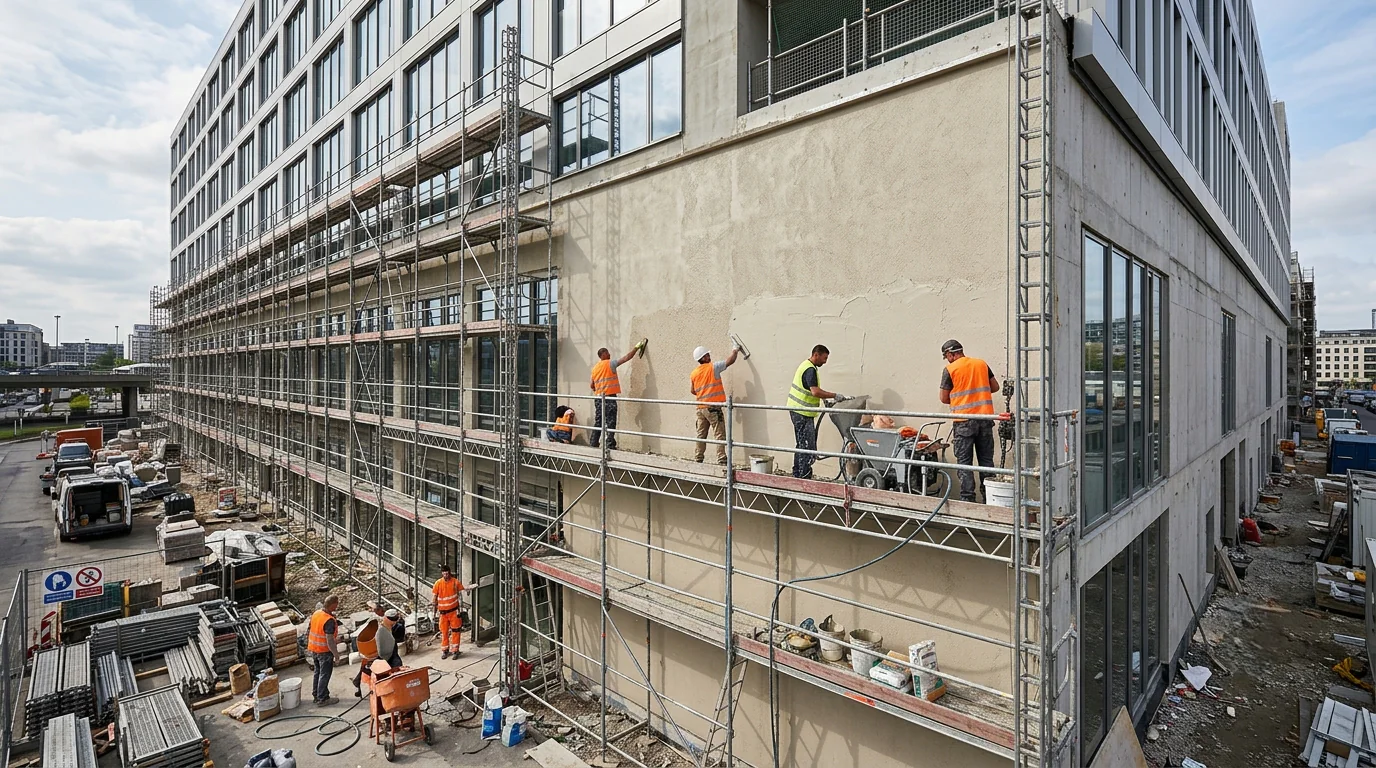
Commercial rendering Melbourne developers and builders rely on isn't just a bigger version of a house facade — it's a genuinely different scope of coordination. Larger crews are needed to keep a program moving, scaffolding or EWP access has to be planned around other trades working the same site, and there's usually a lot more documentation involved, from safety compliance through to material specification sign-off before a single coat goes on.
Scheduling reliability matters more on commercial jobs than almost anything else, since a delayed rendering stage can hold up painters, signage installers and a whole handover date behind it. Weather planning also becomes more critical at scale — a large commercial facade caught mid-application in an unexpected change of conditions is a far bigger problem than a small residential wall. Best Rendering Group has worked commercial rendering across retail fit-outs and larger developments from Dandenong through to Frankston, and the projects that run smoothly are always the ones where scheduling and substrate prep were locked down properly before the crew mobilised, not figured out on the fly.
Confirm safety compliance, material specification sign-off and any council or body corporate approvals are locked in before work starts.
Make sure the contractor can genuinely resource the job at the scale your program needs, not just quote it optimistically.
Confirm who's responsible for scaffolding scheduling and how rendering fits around other trades needing the same access. This coordination is especially important when Concrete Finishing is also part of the scope.
Ask how the contractor plans around weather delays on a large facade, since a partially applied coat left mid-way is a real risk.
Pricing varies by system, wall area and scale. Larger commercial jobs often see a lower per-square-metre rate due to efficiencies of scale, offset by higher overall project coordination costs. These figures are a general guide only.
Is cement rendering still used, or has acrylic replaced it?+
Cement rendering is still very much in use, particularly for heritage restoration, solid masonry work and certain commercial applications where its rigidity actually suits the substrate better than a flexible acrylic system would. Acrylic has become the default for most new residential builds because it copes better with ground movement, but cement rendering hasn't been replaced so much as it's now used more selectively for the applications it genuinely suits best.
How much does rendering cost in Melbourne?+
Residential cement rendering generally runs from around $45 to $70 per square metre, while acrylic systems sit slightly lower at around $40 to $60 per square metre for standard facades. Commercial rendering often has a lower per-square-metre rate due to scale efficiencies, typically from around $35 to $55 per square metre, though total project costs are naturally higher given the size of the job. The stat-card breakdown further up this page covers the common categories.
How long does a commercial rendering project typically take?+
This varies enormously with building size, but most commercial rendering projects run from a few weeks for a smaller retail fit-out through to several months for a larger multi-storey development, once you account for scaffolding, coordination with other trades and cure time between coats across a much bigger surface area. A realistic program with weather contingency built in matters more on commercial jobs than almost any other factor.
Which is more durable, cement rendering or acrylic rendering?+
Both can last decades when applied correctly, but they fail differently. Cement rendering is more prone to hairline cracking if the substrate moves, since it's a rigid system. Acrylic rendering flexes with minor movement, which generally makes it more forgiving on Melbourne's variable soils, but it needs proper base coat cure time to avoid its own set of early cracking issues. Neither system is inherently "more durable" in isolation — it comes down to matching the system to the substrate and getting the installation right.
Do commercial rendering projects need council approval in Melbourne?+
It depends on the scope, the building's classification and whether it's part of a broader development application. Larger commercial rendering projects are often bundled into a wider building permit process managed by the builder or developer, while smaller fit-out rendering may not need separate council sign-off at all. It's worth confirming this with your builder or building surveyor early, since it affects project timelines significantly.
Rendering Melbourne homes and commercial buildings isn't a one-size-fits-all decision. Cement rendering still earns its place on heritage and solid masonry work, acrylic systems have largely taken over new residential builds for good reason, and commercial rendering runs on an entirely different set of scheduling and compliance considerations than either. Getting the right system matched to the right project, with a contractor who can genuinely resource the scale involved, is what actually determines whether a job runs smoothly or turns into a scheduling headache.
Best Rendering Group provides cement rendering, acrylic rendering and commercial rendering across Melbourne's south east, working directly with builders, developers and homeowners on projects from a single residential facade through to full commercial developments. Beyond rendering, the team also handles Moulding Services for projects needing decorative detailing. With more than a decade of hands-on trade experience and fully licensed, insured teams on every job — details worth confirming directly before booking — the system gets matched to the substrate, not the other way around.